Most coffee terms describe one of four things: how the bean was roasted, how finely it was ground, how acidic the cup tastes, and how much caffeine is left in it. This guide defines each term in plain language, gives you the number behind it where a number exists, and corrects the three claims about coffee that almost every buying guide gets wrong. Read the section you need and skip the rest.
A bag of specialty coffee carries more vocabulary than most groceries. Roast level, grind size, acidity, origin, blend, process. None of it is difficult, but very little of it gets explained honestly, and a few of the most repeated explanations are simply wrong.
What follows is the vocabulary with the evidence attached. Where a claim is measurable, we give the measurement and the source. Where the popular version is a myth, we say so and explain what is actually happening instead.
What does the roast level actually change?
Roast level changes which flavors you taste and how much acidity survives into the cup. It does not meaningfully change caffeine. A lighter roast keeps more of the origin character, the fruit and the brightness. A darker roast trades that for body, chocolate, toasted nut, and smoke. Same bean, two different answers.
The clearest way to see the size of that effect is to compare what roasting destroys against what it leaves alone. Across a roast series from light to Italian, researchers measured caffeine moving from 13.08 to 13.66 milligrams per gram, which is essentially flat. Over the same series, chlorogenic acids, the compounds that carry much of coffee's sourness and bitterness, dropped between 56 and 96 percent.
56 to 96 percent of chlorogenic acids are destroyed between a light roast and a dark roast, while caffeine stays essentially unchanged. Roasting is brutal to acids and nearly irrelevant to caffeine. Source: Ali et al., International Journal of Food Science and Technology, 2025.
Roast level
What it does to the cup
On our shelf
Light
Brightest acidity, most origin character, fruit and floral notes, lighter body
Neither end of that range is better. They answer different questions. If you want the longer version, our guide to light, medium, and dark roasts walks through choosing between them.
We cup the same coffee at five-degree intervals, and the shifts between them are dramatic rather than subtle. The clearest example sits on our own shelf. The same Costa Rican beans go into medium-roast Red, White, Brew and French-roast Goat Locker. Side by side, most people would never guess they started as the same coffee.
Dave Stewart, our master roaster and a co-founder of Seattle's Best Coffee, taught me to read a roast that way.
Tim Cruickshank, Founder, BoneFrog Coffee Company
Does light roast have more caffeine than dark roast?
Only if you measure your coffee by the scoop. Per gram, roast level barely matters. Light roast beans are denser and lose less mass in the roaster, so a scoop of light roast holds more actual coffee by weight than the same scoop of dark. The caffeine difference comes from how much coffee you put in, not from caffeine being destroyed.
America's Test Kitchen ran the experiment directly. Brewing by equal volume, light roast produced substantially more caffeine than dark. Brewing by equal weight, the two were, in their words, virtually the same. The reason sits in one line of their results: it took two and a half more tablespoons of dark roast than light roast to reach the same 1.5 ounces.
Caffeine sublimes at 178 degrees Celsius, which is below roasting temperature, so people reasonably assume it burns off. It largely does not, because the caffeine is locked inside the bean matrix rather than sitting on the surface. Measurable loss only begins at the very top of the dark roast range.
The practical version: how you measure your dose matters far more than which roast you buy. If caffeine content matters to you, weigh your coffee instead of scooping it.
Two independent datasets agree. One measured caffeine across six roast levels and found a spread of under five percent. A second, published in the Saudi Journal of Biological Sciences, put light at 1.13 percent of mass, medium at 1.17, and dark at 1.08, and stated plainly that the difference across roast levels is not statistically significant.
What happens inside the bean during roasting?
Roasting converts a dense, grassy-smelling green seed into something aromatic by triggering two chemical reactions and one structural failure. Green coffee has almost none of the flavor compounds we associate with coffee. More than a thousand volatile compounds have been identified in roasted coffee, the majority created during the roast itself, though only around five percent of them meaningfully drive the aroma.
Stage
Temperature
What is happening
Maillard reaction begins
140 C / 284 F
Sugars react with amino acids, producing melanoidins, the brown color and much of the roasted flavor
Caramelization begins
170 C / 338 F
A separate reaction from Maillard, often confused with it. Sugars break down on their own
First crack
roughly 201 to 208 C / 395 to 405 F
Trapped water flashes to steam, the bean audibly cracks and expands, and the roast turns exothermic
Second crack
roughly 225 to 232 C / 438 to 450 F
Accumulated carbon dioxide breaks a now-brittle cellulose structure. Dark roast territory
Crack temperatures vary between roasting machines because bean probes calibrate differently, so treat those as ranges rather than fixed points. Sweet Maria's publishes the figures above. Barista Hustle is the source for the Maillard and caramelization thresholds, and is worth reading if only because it separates the two reactions cleanly where most coffee writing runs them together.
Beans typically lose 14 to 20 percent of their mass during roasting, mostly water. That mass loss is why roast level and bean density move together, and it is the mechanism behind the caffeine-by-scoop confusion above.
Dave Stewart, BoneFrog master roaster and a co-founder of Seattle's Best Coffee, takes a batch from green bean to finished roast.
How fresh does coffee really need to be?
Fresher coffee gives you more aroma, not more caffeine. Caffeine is a stable alkaloid that survives roasting largely intact and does not meaningfully degrade in storage. What disappears as coffee stales is the volatile aromatic compounds, and they go fast.
The Specialty Coffee Association's literature review on staling puts a number on it. Methanethiol, one of the key freshness markers, drops to roughly 30 percent of its original level after eight days. Nothing about caffeine appears in that review at all, which is telling.
The National Coffee Association's storage guidance: whole beans hold their peak for one to three weeks at room temperature, ground coffee for one to two weeks. Ground coffee also releases carbon dioxide at roughly double the rate of whole beans, which is the practical argument for grinding only what you are about to brew.
This is the honest version of the freshness argument, and it is a better one than the caffeine claim it replaces. You are not chasing a stimulant. You are chasing the aromatic compounds that make coffee taste like something. For the full picture, see how long coffee beans actually last.
What does low acid coffee actually mean?
It means lower titratable acidity, not lower pH. Those are different measurements, and the distinction matters because pH barely moves between coffees while titratable acidity moves a lot. Titratable acidity measures the total amount of acid in the cup, and research from UC Davis found it is what correlates with perceived sourness. pH only varies meaningfully between different roast levels.
Brewed coffee sits between pH 4.85 and 5.13. For scale, a study of 380 beverages in the Journal of the American Dental Association measured coffee at 5.11, orange juice at 3.80, and Coca-Cola at 2.37. Because pH is logarithmic, coffee has roughly 20 times fewer free hydrogen ions than orange juice and over 500 times fewer than cola.
Acidity does not fall steadily as a roast darkens. It climbs. A 2024 study in Scientific Reports found titratable acidity peaks at first crack, rising from 2.2 to 4.9 millilitres of sodium hydroxide per 40 millilitres, then decays back to roughly its starting level by second crack.
So a light roast dropped near first crack sits at or near peak acidity. A dark roast taken toward second crack has burned most of it off. This is why roast level is the most reliable lever you have on acidity.
Is cold brew really 67 percent less acidic?
No, and that figure should be retired. It originates with a cold brew equipment manufacturer, has no published methodology, sample size, or measurement basis, and exceeds every value in the peer-reviewed literature. It is a marketing number that got repeated until it sounded like science.
Here is what the research actually shows. Rao and Fuller measured cold and hot brew across six origins and found the pH values comparable, all within that same 4.85 to 5.13 band. Where cold brew genuinely differs is titratable acidity, which ran roughly 10 to 40 percent lower than hot brew depending on origin. A follow-up study found the gap widens as roast darkens, and concluded that roast level influences final acidity more than brewing temperature does.
One more honest caveat, because it matters if you are buying low acid coffee for your stomach. Cleveland Clinic lists four separate mechanisms by which coffee can trigger reflux, and acidity is only one of them. Caffeine relaxing the lower esophageal sphincter and coffee stimulating gastric acid production are unaffected by how acidic the brew is. Lower acidity may help. It is not a cure, and we are not going to pretend otherwise.
Decaf is not caffeine free. USDA FoodData Central puts an 8 ounce cup of brewed decaf at 2.4 milligrams against 94.8 milligrams for regular. Real-world sampling runs higher. A study in the Journal of Analytical Toxicology measured decaf from ten establishments and found 0 to 13.9 milligrams per 16 ounce serving.
Both figures are true. USDA reflects a standardised lab preparation, the analytical study sampled actual retail cups. If you are avoiding caffeine for a medical reason, plan around the higher range.
A note on a number you will see everywhere: the 97 percent caffeine removal figure for decaf is an industry standard, not an FDA regulation. There is no codified federal rule requiring it. What the FDA does regulate is solvent residue, capping methylene chloride at 10 parts per million in decaffeinated roasted coffee under 21 CFR 173.255.
Method
How it works
Swiss Water Process
No solvent. Beans soak in water already saturated with every coffee soluble except caffeine, so only caffeine has anywhere to go. Runs 8 to 10 hours
Supercritical carbon dioxide
CO2 pushed past its critical point behaves as both liquid and gas and dissolves caffeine selectively, because larger aroma molecules are essentially insoluble in it
Ethyl acetate, often called sugarcane process
Uses a naturally derived solvent fermented from sugarcane molasses. Accurate to call it naturally derived, not chemical free
Methylene chloride, the European method
The only method with a hard US federal residue cap. The solvent boils at 39.75 C, far below roasting temperature
BoneFrog uses the Swiss Water Process for Zenfrog Decaf, the first method in that table. It is the only one of the four that uses no solvent at any stage, which is why the cup still reads as coffee rather than as coffee with something taken out of it.
Zenfrog Decaf
Swiss Water Process, medium roast, decaffeinated without solvent. Available in all seven grinds, and in a 4 ounce size if you want to try it before committing to a full bag.
Match the grind to the contact time. The longer water sits with the coffee, the coarser the grind needs to be. Espresso pushes water through in under 30 seconds and needs a fine grind. Cold brew steeps for 12 hours and needs a coarse one. Get this wrong and no other adjustment will save the cup.
Every BoneFrog 12 ounce bag ships in one of seven grinds, cut to the brewer rather than to a generic size label.
Our grind option
Use it for
Approximate size
Whole Bean
Grinding at home, the freshest option if you own a grinder
Not applicable
French Press
French press, and cold brew you steep yourself
Coarse, roughly 800 to 1,200 microns
Pour Over
V60, Chemex, and other pour over cones
Medium coarse, roughly 600 to 900 microns
Drip
Standard automatic drip machines
Medium, roughly 500 to 800 microns
Fine
Moka pot and fine-basket brewers
Fine, roughly 300 to 500 microns
Espresso
Espresso machines
Fine, roughly 200 to 400 microns
Turkish
Turkish and ibrik brewing
Extra fine, roughly 40 to 200 microns
Treat those micron figures as orientation, not gospel. No industry body defines grind categories by particle size, published charts disagree by as much as several hundred microns on the same brew method, and any grind is a distribution of sizes rather than a single one. Your grinder's dial matters more than the number.
100 microns is roughly the maximum depth water can extract into a coffee particle. Barista Hustle's measurements found the interior of any particle much larger than that is essentially never extracted, no matter how long you brew. Grinding finer does not just add surface area, it converts locked-up interior into reachable exterior.
That single fact explains the whole grind conversation. In a 15 second immersion, particles under 250 microns reached 22 percent extraction, particles from 250 to 500 microns reached just under 19 percent, and boulders above 500 microns managed only 14 percent. The Specialty Coffee Association's target window is 18 to 22 percent solubles yield. Grind too coarse and you land below it, which tastes sour and thin. Grind too fine and you push past it, which tastes bitter and drying.
What is the difference between a blend and a single origin?
A single origin is coffee from one place, presented as itself. A blend combines coffees from different origins to hit a fixed flavor target. Blending is not a way to hide lesser coffee, it is how a roaster keeps a promise across a harvest calendar that never repeats itself exactly.
Coffee is agricultural. A single farm's lot exists for a season and then it is gone. If you love a coffee in January, a single origin cannot guarantee you the same cup in July. A blend can, because the components underneath it rotate while the target stays fixed.
Will Corby, Head of Coffee at Pact Coffee, describes swapping the base of an espresso blend to a Rwandan lot for six months of the year and adjusting the roast profile to compensate for its brighter acidity. Same blend, same customer expectation, different green coffee underneath. Jen Apodaca of Royal Coffee's The Crown puts the reason plainly: consumers demand a flavor profile that is repeatable and consistent year round, and a well-built blend delivers a more dynamic profile than a single coffee can offer on its own.
Brew between 90 and 96 degrees Celsius, which is 194 to 205 Fahrenheit, at roughly 55 grams of coffee per litre of water. That is SCA Standard 310-2021, and it works out to about a 1 to 18 ratio by weight. The widely repeated 195 to 205 Fahrenheit figure is close but slightly off at the bottom end.
Variable
Target
Source
Water temperature
90 to 96 C, or 194 to 205 F
SCA Standard 310-2021
Ratio, by weight
55 grams per litre, roughly 1 to 18
SCA Standard 310-2021
Ratio, by volume
1 to 2 tablespoons per 6 ounces of water
National Coffee Association
Extraction yield
18 to 22 percent solubles
SCA Brewing Control Chart v3
Water hardness
150 ppm total dissolved solids, acceptable range 75 to 250
SCAA Water for Brewing Specialty Coffee
Water is the ingredient nobody thinks about and it is 98 percent of the cup. Avoid distilled water, which has nothing for the coffee to bind to, and avoid softened water, which has too much sodium. Filtered tap water is usually right. Our brewing guide works through each variable in order.
Start with one bag you know well
Vocabulary is easier to learn against a reference point. Pick one coffee, learn it, and everything else has something to be different from. A 4 ounce sample size lets you taste across the roast range before committing to a full bag.
Does light roast coffee have more caffeine than dark roast?
Only when you measure by the scoop. Light roast beans are denser and lose less mass during roasting, so a scoop holds more coffee by weight. Measured by weight rather than volume, caffeine is nearly identical across roast levels, because roasting does not meaningfully destroy caffeine.
What does low acid coffee mean?
Low acid coffee means lower titratable acidity, which is the total amount of acid in the cup and the thing your palate actually responds to. It does not mean a higher pH, since nearly all brewed coffee falls between pH 4.85 and 5.13. Darker roasts and cold brewing both lower titratable acidity.
How much caffeine is in decaf coffee?
An 8 ounce cup of brewed decaf contains about 2.4 milligrams of caffeine according to USDA FoodData Central, compared with about 94.8 milligrams for regular coffee. Real-world sampling has measured up to 13.9 milligrams per 16 ounce serving, so decaf is very low in caffeine but not caffeine free.
Is BoneFrog decaf Swiss Water processed?
Yes. Zenfrog Decaf is decaffeinated using the Swiss Water Process, which uses no chemical solvent at any stage. The beans soak in water already saturated with every coffee soluble except caffeine, so caffeine is the only compound with anywhere to go.
What grind size do I need for my coffee maker?
Match grind size to how long the water contacts the coffee. Use a coarse grind for French press and cold brew, medium coarse for pour over, medium for automatic drip machines, fine for espresso, and extra fine for Turkish coffee. Longer contact time needs a coarser grind.
How long does roasted coffee stay fresh?
Whole beans hold their peak flavor for one to three weeks at room temperature and ground coffee for one to two weeks, according to the National Coffee Association. What fades is aroma rather than caffeine, and ground coffee stales roughly twice as fast as whole beans, which is why grinding just before brewing makes a noticeable difference.
Because our gourmet coffee is roasted fresh and is a perishable food product, we cannot accept returns or refunds on any coffee purchases, and all sales are final.
Shipping Information
Once you order, shipping typically takes 3 – 7 business days, depending on where you live.
Customer Service
We’re real people, and we’re happy to help.
Chat or email us at info@bonefrog-coffee.com
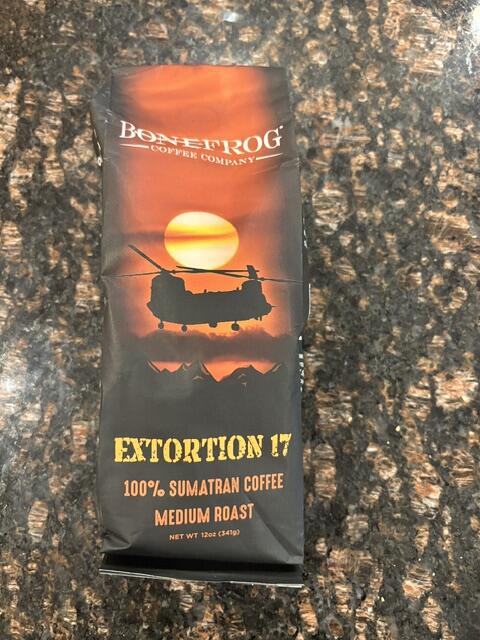
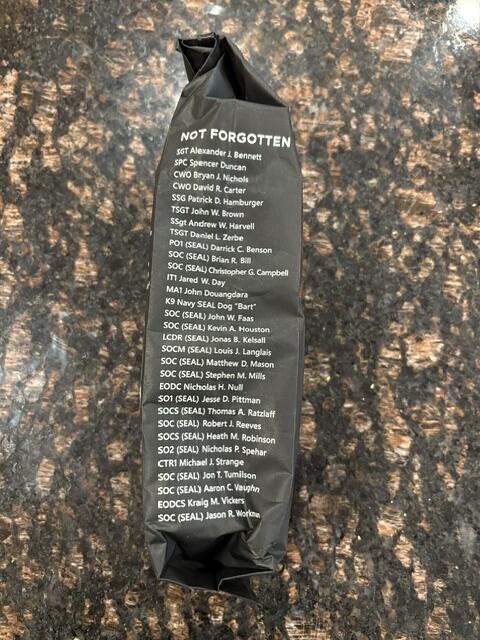
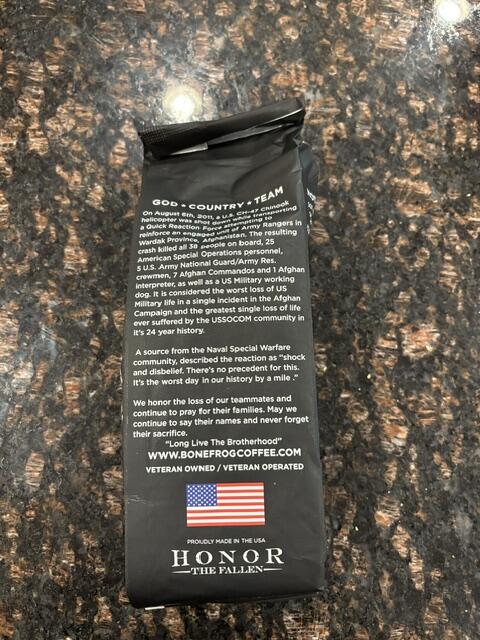
As with all BoneFrog coffees I have tried, Extortion 17 maintains that superb quality so you want to come back for that 2d, 3d and 4th cup! Truly one of the smoothest coffees I've ever had in my 72 years. Extortion 17 is the exact reason that BoneFrog is the only coffee company I order from. Most importantly, the story behind Extortion 17 Coffee is one that everyone should read because the bottom line is this. American military professionals including Navy SEALS and K9 Navy SEAL Dog "Bart" put themselves into harm's way for you and me, and paid the ultimate sacrifice so we can live free. Never forget!